 Jörg Olbing
 AI vs CRM in Real Estate: Why Dashboards Lost
I ran a real estate brokerage for nearly 15 years. During that time, I bought every CRM the market had to offer. I implemented them with enthusiasm, trained my teams, even hired consultants to optimize our workflows. Every single one made the same promise: better visibility, better management, better results.
The visibility came. The results didn’t. What came instead was a slow transformation of my best closers into the most expensive data entry clerks in Germany.
The dashboard culture problem — surveillance disguised as management
Dashboard culture is what happens when the person who buys software and the person who uses software have completely different goals. Managers want visibility into what brokers are doing. Brokers want to close deals. CRMs solved for the manager — and called it productivity.
The result is a surveillance system wearing a productivity costume. Every call logged. Every meeting documented. Every contact field filled. Not because any of it helps the broker sell a single property, but because someone three levels up needs a color-coded chart for their Monday morning meeting.
I know this because I was that someone. At Assetgate, I stacked reporting layers with the best intentions. Activity dashboards. Pipeline stages. Weekly summaries. My brokers spent their Mondays and Tuesdays feeding the machine, then had three days left to do actual work. The data was beautiful. The revenue told a different story.
When Assetgate was acquired by Intrum, the reporting requirements tripled. Corporate needed standardized metrics. My top performers — brokers closing 15 to 18 deals a year — dropped to single digits. Not because they forgot how to sell. Because they ran out of hours to sell in.
What CRMs actually do — track activity, not close deals
A CRM is a database with a pretty face. It stores contacts, logs interactions, and generates reports. That is genuinely all it does. The value proposition is visibility: managers can see who called whom, which deals are in which stage, and who filed their weekly report on time.
Here is what a CRM cannot do: it cannot find your next lead. It cannot qualify a prospect. It cannot prepare a market analysis for your listing appointment. It cannot follow up with the 23 contacts you didn’t have time to call today. It cannot do any of the work that actually generates revenue.
The industry has spent two decades confusing tracking work with doing work. A broker who logs 40 calls in the CRM looks productive. A broker who closed three deals but logged nothing looks lazy. The incentive structure rewards performance theater, not performance.
Research from the National Association of Realtors consistently shows that brokers spend 72% of their working time on administrative tasks. CRMs didn’t create all of that overhead. But they certainly didn’t reduce it. In many offices, they are the single largest contributor.
What AI teammates do — prepare, qualify, deliver so you can close
An AI teammate is not a smarter database. It is a colleague that works while you sleep, prepares what you need before you ask, and never requires you to type a single status update.
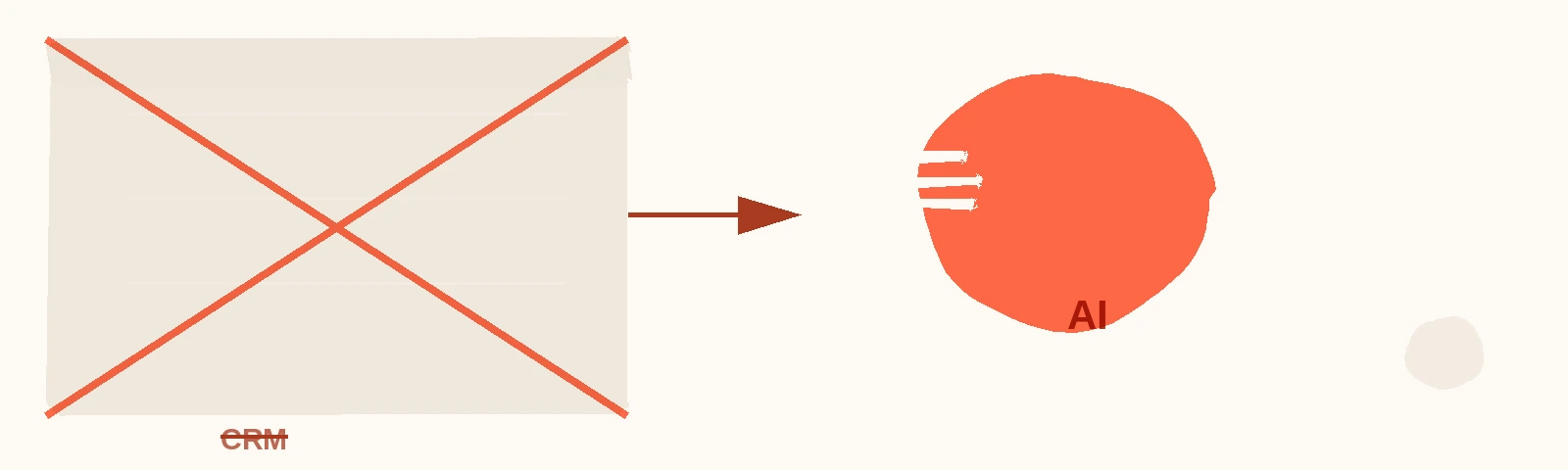
The difference is fundamental. A CRM waits for you to enter data. An AI teammate generates the data. A CRM tracks that you made a call. An AI teammate tells you who to call next, why they are likely to sell, and what comparable properties closed in their neighborhood last month.
Think of it as the difference between a filing cabinet and an assistant. The filing cabinet stores whatever you put in it and retrieves it when you ask. The assistant anticipates what you need, prepares it, and puts it in front of you at the right moment. One creates work. The other eliminates it.
AI lead generation, for example, can scan public records, identify homeowners likely to sell based on ownership duration and life events, and deliver qualified prospects directly to a broker’s phone — all without the broker lifting a finger. That is not a feature you add to a CRM. That is a fundamentally different relationship between a broker and their tools.
The “6-to-20 Agent” transformation — what happens when admin disappears
I saw this at Assetgate before I had the language for it. One broker on my team — solid but never spectacular — was closing about 6 deals a year while the team average was 10. I gave him an assistant to handle all CRM entries, reports, and status updates. His only job was to talk to prospects and close.
Twelve months later: 14 closed transactions. Same broker. Same market. Same skills. He just got 25 hours a week back.
That is what I call the 6-to-20 transformation. The ceiling on most brokers is not talent or market knowledge. It is time. Remove the administrative burden and the same person, with the same skills, in the same market, produces dramatically more. The math is straightforward: if a broker reclaims even half of that 72% administrative overhead, they more than double their available selling hours.
The question is no longer whether admin reduction works. The question is whether you achieve it with a human assistant at EUR 35,000 per year or an AI team at EUR 69 per month.
Daily workflow comparison — a broker’s Tuesday with CRM vs AI teammate
Tuesday with a CRM:
- 8:00 — Open CRM, update pipeline stages from yesterday’s conversations
- 8:45 — Log three calls from yesterday that you forgot to record
- 9:15 — Search portal sites manually for new FSBO listings
- 10:00 — Scroll through lead database, try to figure out who to call first
- 10:30 — Finally make first prospecting call
- 12:00 — Lunch, check email for portal notifications
- 13:00 — Prepare comparative market analysis manually for afternoon listing appointment
- 14:30 — Listing appointment (actual revenue-generating activity)
- 16:00 — Enter appointment notes into CRM, update deal stage
- 16:30 — Mandatory weekly pipeline report for team lead
- 17:00 — Realize you didn’t follow up with three hot leads. They’ve gone cold.
Tuesday with an AI teammate:
- 8:00 — Check WhatsApp. Your AI team has already delivered: 4 new qualified leads found overnight, a market analysis prepared for your 10:00 appointment, and a reminder that a seller you spoke to last week just reduced their asking price on a portal
- 8:15 — First prospecting call. The lead brief is already in front of you.
- 12:00 — Lunch
- 13:00 — Second listing appointment. Market analysis was waiting in your chat before you woke up.
- 15:00 — Review three new leads that came in during your appointments
- 16:00 — Done. Your AI team is still working. You’re heading home.
That is not science fiction. That is the difference between a system that creates work and a colleague that does work. Speed-to-lead data shows that responding within 5 minutes increases conversion by 900%. No human buried in CRM updates can consistently hit that window. An AI teammate can.
When you still need a CRM (and when you genuinely don’t)
I am not going to tell you to burn your CRM tomorrow. That would be dishonest. There are scenarios where a traditional CRM still earns its place.
You probably still need a CRM if:
- You run a team of 50+ agents and regulatory compliance requires documented audit trails
- Your franchise agreement mandates a specific system
- You have invested years building automations that genuinely work and generate revenue
You probably don’t need a CRM if:
- You are a solo broker or small team spending more time updating the system than using it
- Your CRM is primarily a reporting tool for management, not a selling tool for you
- You chose your CRM because “everyone uses it,” not because it makes you faster
- You pay EUR 50 to 200 per month for software that you resent opening every morning
The honest assessment: most brokers I talk to across Europe fall into the second category. They maintain their CRM out of habit, not conviction. The moment a genuine alternative exists — one that delivers leads, prepares materials, and follows up automatically without requiring manual data entry — the CRM becomes a relic. Not because CRMs are bad technology. Because they solve the wrong problem.
The future — AI-first workflows with zero manual data entry
By 2028, the standard real estate brokerage will run on an AI-first workflow where the broker’s primary interface is a conversation, not a database. Leads will arrive pre-qualified. Market analyses will generate automatically. Follow-ups will happen without human intervention unless the broker wants to step in.
The CRM will not disappear entirely. It will become invisible — a background layer that organizes data without ever asking the broker to touch it. The broker’s job will return to what it was always supposed to be: building relationships and closing deals.
I built the surveillance machine myself for years. I watched what it did to good people. I bet my own exit money — the proceeds from selling Assetgate — on the thesis that there is a better way. Not better tracking. Not a friendlier interface on the same database. A fundamentally different model where AI does the preparation and the broker does the closing.
CRMs track. Conversations close. The industry is finally ready to understand the difference.