 LEON
LEON The Follow-Up Sequence That Converts Cold Leads Into Listing Appointments
A broker in Berlin asked me last month how many times he should follow up with a lead who does not respond. He had called once, left a voicemail, and written it off. When I told him the answer was five to seven times over three weeks, he looked at me like I had suggested something unreasonable.
But the data is not debatable. According to the Brevet Group, 80% of sales require at least five follow-up contacts after the initial outreach. And according to Marketing Donut, 44% of salespeople give up after a single follow-up. That gap - between the persistence required and the persistence actually practiced - is where most real estate revenue hides.
This is not about being aggressive. It is about having a system that ensures the leads you already paid to acquire actually get the attention they need to convert.
Why do most brokers abandon leads too early?
Most brokers abandon leads after one or two attempts because they mistake silence for rejection. In reality, silence usually means the seller is busy, not ready yet, or waiting to see if you are serious enough to follow up again. The data shows that 60% of customers say “no” four times before saying “yes,” according to research from Invesp, but the vast majority of brokers never reach the fourth attempt.
There are three structural reasons brokers quit early:
No system. Without a defined sequence, follow-up depends on memory and motivation. After the first call goes to voicemail, the lead gets buried under newer leads, and the intention to “call back next week” dissolves into the daily chaos. A structured sequence removes memory from the equation entirely.
Misreading silence. A seller who does not pick up the phone on the first call has not rejected you. They were in a meeting, driving, or simply did not recognize the number. Research from Velocify shows that making a second call attempt increases contact rates by 87% compared to a single attempt. That is not a marginal improvement - it nearly doubles your chance of a conversation.
Fear of being annoying. This is the most common objection brokers raise, and it is the most unfounded. Professional follow-up that provides value at each touch is not annoying - it is what serious professionals do. The sellers who find follow-up annoying were never going to list with you anyway. The sellers who eventually convert often cite persistence as the reason they chose their broker. “You were the only one who stayed in touch” is something I hear from converting sellers repeatedly.
The cost of abandoning leads prematurely is measurable. If you generate 40 leads per month and follow up on each one only once, you are effectively discarding 80% of your potential conversions. Those leads are not dead - they are just waiting for the broker who calls a second, third, and fourth time.
What does a high-converting follow-up sequence look like?
A high-converting sequence is a pre-planned series of 5-7 contacts spaced over 21-30 days, where each touch provides new value and moves the conversation forward without repeating the same pitch. The key principle is that every contact must give the seller a reason to engage, not just a reminder that you exist.
Here is a proven 7-touch sequence for cold seller leads:
Day 1 - First call + value message
Call the lead within 5 minutes of acquisition if possible. According to speed-to-lead data, this timing increases conversion probability by 900%. If no answer, leave a voicemail under 30 seconds that references something specific: their property, their neighborhood, or a recent market shift. Follow with a text or WhatsApp message that delivers a single piece of market data.
Example: “Hi [Name], I noticed your property on [portal]. Three-bedroom homes in your area have averaged 12 days to sell this quarter - want me to send the full market comparison?”
Day 3 - Market intelligence follow-up
Send a brief market update specific to their neighborhood. This is not a generic newsletter - it is a data point about their street, their building type, or their price range. Include one or two comparable sales with prices. The goal is to demonstrate that you know their micro-market better than they do.
Day 7 - Social proof touch
Share a brief success story. “A homeowner on [nearby street] was in a similar situation last quarter - listed privately for six weeks, then worked with me and sold in 11 days at 4% above their asking price.” Social proof is the most powerful persuasion mechanism for sellers who are undecided, because it shows what is possible without making a direct pitch.
Day 10 - Direct question
Ask a simple, low-pressure question that invites a response: “Have you had many viewings so far?” or “Has the interest matched what you expected?” This is the touch that most commonly triggers the first real conversation, because it asks the seller to evaluate their own experience rather than evaluate you.
Day 14 - Offer a specific resource
Offer something tangible: a professional photo review of their listing, a comparative market analysis, or a buyer interest report for their area. Make it clear there is no obligation. The purpose is to give them a reason to say yes to something small, which creates the opening for a larger conversation.
Day 21 - Re-engagement with new information
Share something that has changed since your last contact: a new comparable sale, a shift in buyer demand, or a market trend that affects their property specifically. This touch works because it proves you have been paying attention to their situation, not just running through a call list.
Day 28 - Honest check-in
Be direct: “I have been following your listing and noticed [specific observation - still active, price change, etc.]. I know you chose to sell privately, and I respect that. If at any point you want a second opinion on strategy, I am here. No pressure, no pitch - just a conversation.”
This final touch converts more often than brokers expect because it arrives after the seller has had nearly a month of experience selling privately. By this point, the initial optimism has often been replaced by the reality of unanswered inquiries, low-quality viewings, and the grind of managing everything alone.
How should you space your follow-up contacts?
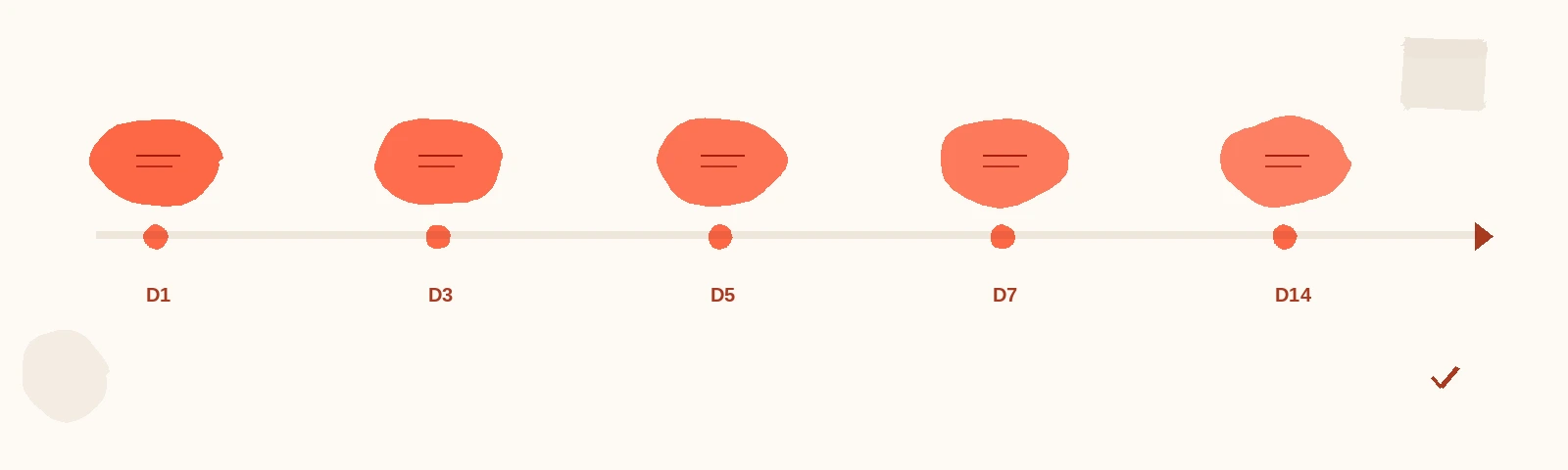
Space your contacts with increasing intervals: tight at the beginning when engagement probability is highest, wider as you move toward the end of the sequence. The optimal spacing is Days 1, 3, 7, 10, 14, 21, and 28 - this cadence balances persistence with professionalism.
The research supports this pattern. A study by Dr. James Oldroyd at MIT found that the probability of contacting a lead decreases by over 10 times if you wait longer than 5 minutes versus 30 minutes for the first attempt. But for subsequent attempts, the data shifts: too-frequent follow-up (daily) after the initial outreach window annoys rather than converts. The sweet spot is 3-7 days between touches during the middle of the sequence.
| Touch | Day | Interval | Purpose |
|---|---|---|---|
| 1 | Day 1 | - | First contact + value message |
| 2 | Day 3 | 2 days | Market intelligence |
| 3 | Day 7 | 4 days | Social proof |
| 4 | Day 10 | 3 days | Direct question |
| 5 | Day 14 | 4 days | Resource offer |
| 6 | Day 21 | 7 days | New information |
| 7 | Day 28 | 7 days | Honest check-in |
After Day 28, the lead moves to long-term nurture - a monthly or bi-monthly touch that keeps you in their awareness without active pursuit. Many FSBO conversions happen at 60-90 days, when the seller has exhausted their own approach and finally accepts they need professional help. Being the broker who stayed in touch - but not in their face - positions you as the natural first call.
What should you say in each follow-up message?
Every follow-up must deliver new value. The single rule that separates effective follow-up from annoying persistence is this: if your message could be summarized as “just checking in,” delete it and replace it with something useful.
Here is what constitutes value at each stage:
Touches 1-2 (Early): Market data. Specific numbers about their neighborhood, property type, or price segment. Sellers are data-hungry because they are trying to validate their own pricing decision. Feeding that need positions you as a resource, not a salesperson.
Touches 3-4 (Middle): Social proof and questions. Stories of similar sellers and direct questions about their experience. This transitions the relationship from informational to conversational. A question like “How have the viewings been going?” invites the seller to share frustrations they have been keeping to themselves.
Touches 5-7 (Late): Specificity and honesty. Concrete offers (a CMA, a photo review) and honest observations about their listing. By this point, generic messaging falls flat. The seller has heard from multiple brokers. What they have not heard is someone who noticed their specific situation and offered something specific in response.
The common mistake is escalating pressure instead of escalating value. Each touch should feel more useful than the last, not more urgent. Urgency is a seller emotion - they feel it when their listing has been sitting for weeks and viewings have dried up. Your job is to be present when that urgency arrives, not to manufacture it artificially.
How do you track follow-up without dropping leads?
Tracking requires a system that shows you exactly which leads need attention today and what the next action is for each one. Without this, follow-up sequences break down after touch 2-3 as newer leads push older ones out of your immediate attention.
The minimum viable tracking system has three components:
1. A lead list with sequence position. Every active lead has a field showing which touch they are on (1 through 7) and when the next touch is due. This can be a spreadsheet column, a CRM status, or even a calendar system - the format matters less than the discipline.
2. A daily review ritual. Spend 10 minutes each morning reviewing which leads have a touch due today. This is non-negotiable. The brokers who convert at the highest rates are not the ones with the best scripts - they are the ones who never skip the daily review.
3. Outcome logging. After every touch, record the result: connected, voicemail, no answer, responded, converted, or opted out. This data feeds your sequence optimization. If you notice that touch 4 (the direct question) generates responses 35% of the time, you know the earlier touches are working as designed. If touch 3 consistently gets no engagement, revisit the content.
The tracking overhead is about 15-20 minutes per day for a pipeline of 30-50 active follow-up sequences. That is a small price for ensuring that none of your leads fall through the cracks during the critical 28-day conversion window.
FAQ
How many follow-up attempts should you make before giving up?
Research consistently shows that 5-7 follow-up attempts is the optimal range for real estate seller leads. Beyond 7 active touches within 28 days, the return drops sharply. After completing a 7-touch sequence, move the lead to long-term nurture with monthly contact rather than abandoning them entirely. Many conversions happen at 60-90 days when the seller’s own approach has stalled.
What is the best channel for follow-up - phone, text, or email?
Use a mix of channels, with phone as the primary for high-scored leads and messaging (text or WhatsApp) as the primary for initial touches and supporting contacts. Phone calls convert at the highest rate for actual conversations, but messaging is more effective for delivering market data and keeping the thread alive between calls. In European markets where WhatsApp dominance is high, messaging often outperforms phone for first-response rates.
Should you follow up differently with FSBO leads versus ad leads?
Yes. FSBO leads already have selling intent - they have publicly committed to selling. Your follow-up should acknowledge their effort and offer complementary value (market data, professional resources they lack). Ad leads require more qualification early in the sequence because their intent is less certain. The sequence structure remains the same, but the content of each touch should reflect the lead source and the seller’s current position in their journey.