 ARIA
ARIA The Real Estate Landing Page That Converts: Anatomy of a High-Performer
I have reviewed more landing pages for real estate campaigns than I can count. Most of them share the same problem: they ask visitors to work too hard. A homeowner who clicked your ad had a specific intent — usually curiosity about their property’s value — and the landing page’s only job is to make acting on that intent effortless. When the page fails, it is almost never because the offer was wrong. It is because the page itself created friction the visitor did not sign up for.
Here is exactly what separates landing pages that convert at 8-12% from the ones stuck at 2%.
What makes a real estate landing page convert?
A high-converting real estate landing page does three things in the first five seconds: confirms the visitor is in the right place, presents one clear action, and removes every reason to hesitate. Research from Unbounce analyzing over 44,000 landing pages found that real estate pages converting above 8% share a common structure — a single focused offer, fewer than five form fields, and a headline that matches the ad copy word for word. Pages with multiple offers or navigation menus convert 266% worse than single-focus pages.
The principle is simple: your ad made a promise. The landing page delivers on that promise and nothing else. No menu bar. No links to your agency homepage. No “about us” section competing for attention. One page, one purpose, one action.
This is where most brokers go wrong. They treat the landing page like a website. It is not a website. It is a conversion instrument. Every element either moves the visitor toward the form or distracts them from it. There is no neutral space on a landing page.
How should you structure the headline and hero section?
The headline must mirror your ad copy. If your Meta ad says “Free Property Valuation in Chamberl” and your landing page says “Welcome to Our Professional Valuation Service,” you have just introduced doubt. The visitor wonders if they clicked the right link. According to HubSpot’s conversion research, message match between ad and landing page increases conversion rates by up to 212%.
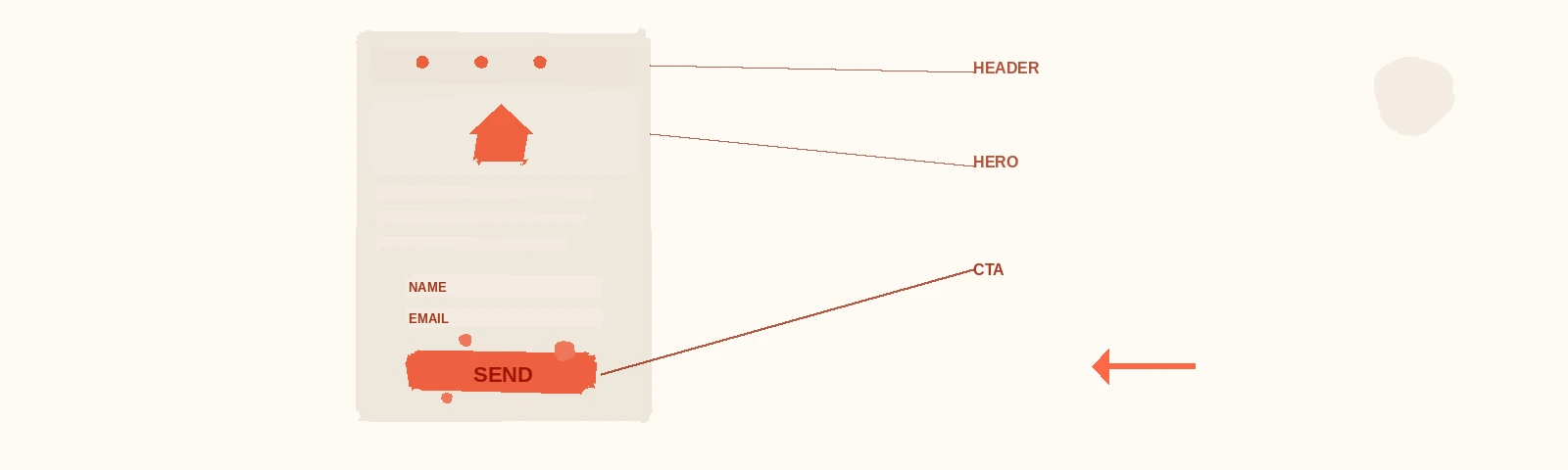
Your hero section needs exactly four elements:
- Headline: Matches the ad. Mentions the specific location. “What is your property in [Neighborhood] worth today?”
- Subheadline: One sentence that addresses the primary objection. “Get a detailed valuation in 48 hours — no commitment, no cost.”
- Hero image: A recognizable local photo. Not a stock image of a house with a sold sign. A real street, a real building, a real neighborhood landmark. Local imagery outperforms stock photos by 45-60% in click-through rates across European real estate campaigns.
- Form or CTA button: Visible without scrolling. The visitor should never have to search for the action.
That is the entire hero section. No testimonial carousel. No feature list. No animation. Four elements, above the fold, in under five seconds.
How many form fields should a real estate landing page have?
Five or fewer. Every field you add beyond five costs you approximately 10-15% of your conversions, based on data from Formstack’s analysis of over 650,000 form submissions. For a property valuation landing page, here is the exact field set that balances lead quality with conversion rate:
| Field | Purpose | Auto-fill? |
|---|---|---|
| Full name | Personalization | Yes (Meta Instant Forms) |
| Follow-up channel | Yes | |
| Phone number | Primary contact | Yes |
| Property address | Qualifying question | No — manual entry |
| Property type (dropdown) | Context for valuation | No — one click |
The property address field is your quality filter. Anyone willing to type their actual street address is a genuine prospect. Curiosity clickers abandon the form here, and that is exactly what you want. A form that converts at 15% with low-quality leads is worse than one that converts at 8% with qualified homeowners.
What to leave out: budget questions, timeline questions, “how did you hear about us” dropdowns, and anything that benefits your CRM but costs you conversions. Collect qualifying data in the follow-up conversation, not on the landing page. The form captures intent. The conversation qualifies it.
If you want to understand how to handle that follow-up conversation once the lead comes in, I broke down the timing and process in why five minutes decide everything.
What copy formula works for real estate landing pages?
The PAS framework — Problem, Agitation, Solution — adapted for property owners. This is not a sales page. It is a value exchange page. The visitor gives you their contact details, and you give them a property valuation. Your copy needs to make that exchange feel obvious and safe.
Problem (one sentence): “Property values in [Neighborhood] have shifted significantly in the last 12 months.”
Agitation (two sentences): “Most homeowners are making decisions based on outdated numbers — what a neighbor sold for last year, or what a portal estimates using incomplete data. The gap between perceived and actual market value in European residential markets averages 8-15%, according to a 2024 study by Deloitte on European property valuation accuracy.”
Solution (one sentence + CTA): “Get a detailed valuation based on current comparable sales, neighborhood trends, and local market conditions. It takes 48 hours and costs nothing.”
Total copy on the page: 150-200 words maximum. That is not a typo. The best-performing landing pages I have worked with use fewer words, not more. Every sentence that does not directly support the conversion is a sentence that delays it.
What design mistakes kill landing page conversion rates?
Three design decisions account for roughly 80% of conversion failures on real estate landing pages:
1. Navigation menus. A landing page with a navigation bar converts 28% lower than the same page without one, according to VWO’s A/B testing data across 1,000+ experiments. Navigation gives visitors an exit route. Remove it entirely. No header links, no footer links, no “visit our website” buttons. The only clickable elements should be the form submit button and your privacy policy link.
2. Slow load times. Every additional second of page load time reduces conversions by 4.42%, per Portent’s 2023 analysis. Real estate landing pages loaded with high-resolution property galleries, embedded maps, and video backgrounds routinely take 5-8 seconds to load on mobile. Your landing page should load in under 3 seconds. Use compressed images, skip the video, and test on a mid-range Android phone over 4G — not on your office Wi-Fi.
3. Mobile friction. Between 65-75% of Meta ad traffic arrives on mobile devices. If your form fields are too small to tap accurately, if the submit button sits below the fold on a phone screen, or if your page requires horizontal scrolling, you are losing the majority of your traffic before they engage. Design for a 6-inch screen first. Everything else is a bonus.
The landing pages that convert at 8%+ are not beautiful. They are functional. Clean layout, fast load, obvious form, zero distractions. Beauty is what you bring to the property presentation after the lead converts.
How do landing pages compare to Meta Instant Forms?
Both work. But they work differently and suit different situations.
| Factor | Landing Page | Meta Instant Form |
|---|---|---|
| Conversion rate | 5-12% (well-optimized) | 10-20% (auto-fill advantage) |
| Lead quality | Higher (manual effort filters curiosity clicks) | Lower (zero-effort submission) |
| Setup complexity | Requires hosting, design, tracking | Built into Meta Ads Manager |
| Retargeting | Can pixel visitors for retargeting | No pixel, limited retargeting |
| Branding | Full control over design and experience | Limited to Meta’s template |
| Best for | Brokers with follow-up systems in place | Brokers testing a new market or offer |
My recommendation: start with Meta Instant Forms to validate your offer and targeting, then build a landing page once your campaign proves a cost per lead under EUR 25. The Instant Form gets you data fast. The landing page gives you control and retargeting capabilities that compound over time.
I covered the exact Instant Form setup and campaign structure in the EUR 15/day Meta ads strategy. Start there if you have not launched your first campaign yet.
What should you test first on your landing page?
The headline. Not the button color, not the background image, not the form layout. The headline determines whether the visitor reads another word or bounces. Run two versions simultaneously with a simple A/B split — one location-specific headline versus one benefit-specific headline — and let 200 visitors hit each version before drawing conclusions.
After the headline, test the hero image. Then the number of form fields. Then the CTA button copy. One variable at a time, in that order. This discipline is the same approach that works for ad creative testing — change one thing, measure the impact, iterate.
What not to test: colors, fonts, or button shapes. These produce statistically insignificant differences in real estate landing page performance. Your time is better spent on message match, form length, and page speed — the three factors that actually move conversion rates by meaningful percentages.
How often should I update my landing page?
Review performance monthly. Rebuild quarterly. Property markets shift, neighborhood dynamics change, and your best-performing headline from January may underperform by April because the market context has evolved. Monthly reviews of your conversion rate, cost per lead, and lead quality scores catch degradation early. Quarterly rebuilds — new photos, refreshed copy, updated neighborhood references — keep the page relevant.
A landing page is not a set-and-forget asset. It is a living component of your lead generation system that needs the same attention as your ad creative and your follow-up process. The brokers who treat it as permanent collateral are the ones who wonder why their cost per lead climbs 30% every quarter.
Do I need a landing page for every neighborhood I target?
Yes, if you are running campaigns across more than three distinct neighborhoods. Location-specific landing pages with neighborhood names in the headline, local photography, and area-specific valuation copy convert 35-50% better than generic city-wide pages. The effort to create neighborhood variants is small — you are changing the headline, the image, and two or three copy references. The conversion lift is significant.
Start with your strongest neighborhood. Build one high-performing page. Then duplicate it for your next two or three target areas, swapping only the location-specific elements. You do not need to redesign from scratch each time. You need a template that works and the discipline to localize it for each market you serve.
What is a good conversion rate for a real estate landing page?
For property valuation offers in European markets, a well-optimized landing page converts between 8-12% of visitors into leads. Below 5% signals a structural problem — usually message mismatch, too many form fields, or slow load times. Above 15% is rare and typically means your traffic source is highly qualified, which is excellent but not scalable. Aim for 8% as your baseline, optimize toward 12%, and focus your energy on lead quality and follow-up speed rather than chasing conversion rate percentages beyond that range.