 LEON
LEON Qualifying Leads by Source: Why FSBO, Ads, and Referrals Need Different Approaches
Qualifying Leads by Source: Why FSBO, Ads, and Referrals Need Different Approaches
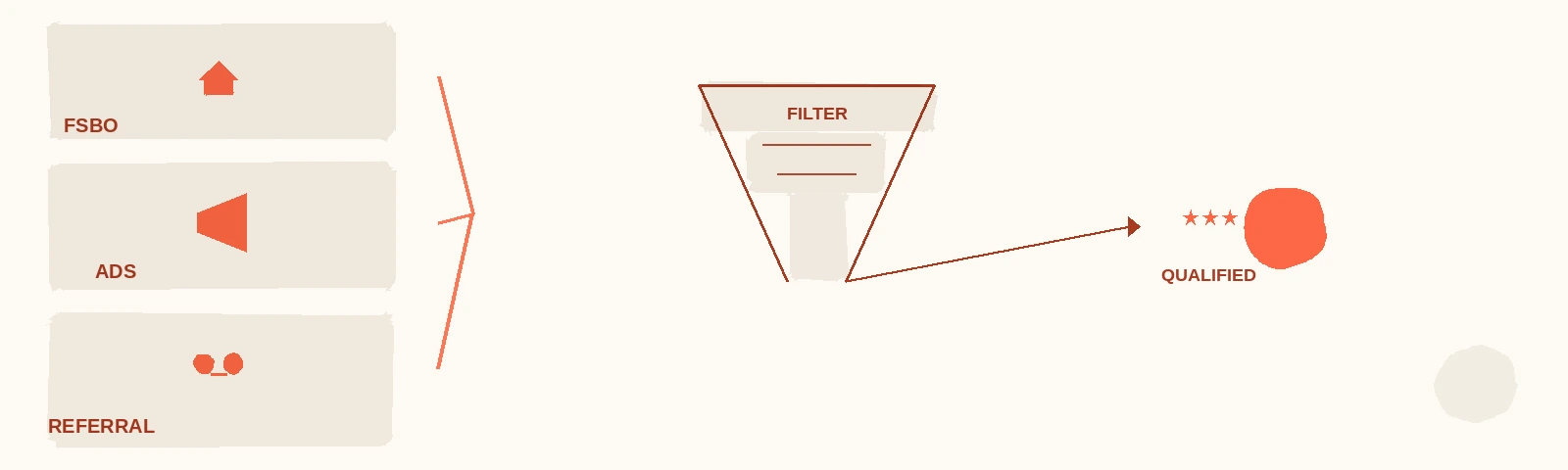
A lead is not a lead. A private seller who listed their apartment on a portal yesterday, a homeowner who clicked on a free valuation ad, and a referral from a past client all represent potential listings — but they are at completely different stages of readiness, carry different motivations, and respond to different qualification approaches. Treating them the same is the fastest way to waste effort on leads that were never going to convert and lose leads that should have been easy wins.
This playbook breaks down the three most common lead sources for residential real estate brokers, explains how to qualify each one differently, and shows why a source-specific approach outperforms a one-size-fits-all script.
Why does lead source matter for qualification?
Lead source determines motivation level, trust baseline, and timeline — the three factors that control whether a conversation becomes an appointment. According to the National Association of Realtors, 63% of sellers say they chose their agent based on the agent’s understanding of their specific situation (NAR 2023 Profile of Home Buyers and Sellers). A generic pitch signals the opposite of understanding.
Each source enters your pipeline with a different mindset:
| Source | Motivation | Trust Level | Typical Timeline | Conversion Rate |
|---|---|---|---|---|
| FSBO | High — already decided to sell | Low — skeptical of agents | 1-4 weeks | 2-3x cold leads |
| Ad leads (valuation) | Curious — exploring the idea of selling | Neutral — responded to an offer | 2-12 weeks | Depends on follow-up speed |
| Referrals | Varies — but comes with built-in trust | High — transferred from trusted source | 1-8 weeks | 4-5x cold leads |
These are different conversations. Using the same opening, the same questions, and the same timeline expectations across all three is like using the same key for three different locks.
How do you qualify FSBO leads?
FSBO sellers have already made the decision to sell. They are not exploring. They are executing. Your qualification should respect that decision and focus on three questions: why they are selling privately, what their timeline looks like, and whether they have realistic price expectations. According to data from the National Association of Realtors, 36% of FSBO sellers eventually list with an agent — and the most common reason is difficulty finding the right buyer or pricing the property correctly.
The FSBO qualification framework
Step 1: Acknowledge their choice (first 30 seconds)
FSBO sellers expect agents to criticize their decision to sell privately. Disarm that expectation immediately.
Do not say: “I see you’re trying to sell on your own — have you considered working with a professional?”
Instead say: “I noticed your listing on [portal]. The property looks well-presented. I work this neighborhood regularly and wanted to share some comparable data that might be useful, regardless of whether you work with an agent.”
Step 2: Ask the three diagnostic questions
| Question | What It Reveals | Follow-up |
|---|---|---|
| ”How long have you been on the market?” | Timeline pressure and frustration level | If > 30 days, they may be open to help |
| ”Have you received offers yet?” | Demand reality check | If yes, ask about offer vs. asking price gap |
| ”How did you arrive at your asking price?” | Pricing sophistication | If portal estimates only, you have value to offer |
Step 3: Offer value before asking for anything
The qualifying move with FSBO sellers is providing something useful. Share a specific comparable — not a generic market report, but a specific recent sale in their building or street with price per square meter. This demonstrates expertise and creates reciprocity.
For a detailed breakdown of FSBO lead generation strategies, including how AI monitoring changes the timing game, see the dedicated FSBO guide.
FSBO red flags (leads to deprioritize)
- Overpriced by more than 20% with strong emotional attachment — They are not ready to hear market data yet. Follow up in 60 days.
- Testing the market with no real intent to sell — Ask: “If you received a fair offer this week, would you accept?” If the answer involves extensive conditions, they are exploring, not selling.
- Hostile to agent contact — Some private sellers have strong anti-agent beliefs. One attempt is enough. Note the property and check back when the listing gets stale.
How do you qualify ad-generated leads?
Leads from advertising — particularly free valuation campaigns — are fundamentally different from FSBO leads. These homeowners have not decided to sell yet. They are curious about their property’s value, which may or may not lead to a listing decision. According to a study by Placester, only 12-15% of valuation ad leads convert to a listing within 90 days. However, the 18-month conversion rate climbs to 35-40% with consistent follow-up.
The qualification challenge with ad leads is separating genuine pre-sellers from casual browsers.
The ad lead qualification framework
Step 1: Respond fast, but adjust expectations
Ad leads have a different speed dynamic than FSBO. Speed still matters — responding within five minutes increases connection rates significantly. But the conversation tone is exploratory, not transactional.
Do not say: “Are you thinking of selling?”
Instead say: “Thank you for requesting a valuation. I have some initial data to share — is this a good time for a quick two-minute call?”
Step 2: The motivation spectrum assessment
Ad leads fall on a spectrum. Your job is to identify where they sit:
| Category | Signals | Approach |
|---|---|---|
| Active pre-seller (15%) | Asks about timeline, mentions life change, already comparing agents | Fast track — treat like warm FSBO. Offer in-person valuation within 48 hours. |
| Exploring seller (35%) | Curious about price, mentions “maybe next year,” checks market periodically | Nurture — provide valuation, schedule quarterly check-ins, send market updates. |
| Casual browser (50%) | Just wanted to see a number, no plans to sell, refinancing interest | Classify and park — send annual update, no active follow-up. |
Step 3: The two qualifying questions for ad leads
-
“What prompted you to request a valuation right now?” — The answer tells you everything. Life change (divorce, job relocation, inheritance) means high motivation. “Just curious” means low motivation. “Thinking about it for next year” means medium.
-
“When was the last time you had a professional valuation done?” — If never, you are providing something genuinely new and useful. If recently, they are comparing — which means they are further along than they admit.
The follow-up cadence for ad leads
The 12-15% who convert within 90 days are the easy wins. The real value is in the 35-40% who convert within 18 months. That requires a structured follow-up cadence:
| Timeframe | Action |
|---|---|
| Day 0 | Call + valuation delivery |
| Day 3 | Follow-up message: “Any questions about the valuation?” |
| Day 14 | Market update for their area |
| Month 2 | Check-in: “Anything changed with your plans?” |
| Quarterly | Market update with new comparables |
Brokers who maintain this cadence — rather than giving up after the first call — capture significantly more listings from the same ad spend.
How do you qualify referral leads?
Referral leads arrive with pre-built trust. The person who referred them has already vouched for you, which means the trust baseline is higher than any other source. According to the National Association of Realtors, 41% of sellers found their agent through a referral from a friend, neighbor, or relative — and referral-sourced clients are 4 to 5 times more likely to close a transaction than cold leads (NAR 2023).
But “trust” does not mean “qualified.” Referrals still need qualification — just a different kind.
The referral qualification framework
Step 1: Honor the referral source (first 30 seconds)
Always mention who referred them and express genuine appreciation. This reinforces the trust chain and signals that you value relationships.
“[Referrer name] mentioned you might be thinking about selling. They are a great client and I am glad they thought of me. Before anything else — what is most important to you right now?”
Step 2: Assess readiness without pressure
Referral leads are sensitive to feeling sold to because they came through a personal relationship, not a commercial channel. The qualification should feel like a conversation, not an intake form.
| Question | Purpose |
|---|---|
| ”What is driving your thinking about selling?” | Identifies motivation and timeline |
| ”Have you started looking at what’s happening in your area market-wise?” | Reveals how far along they are in the process |
| ”Is there a timeline that matters to you — a move, a life change, a financial goal?” | Connects selling to a real need, not just curiosity |
Step 3: Set expectations based on their timeline
Referral leads tend to have longer timelines because they are often in early-stage planning. That is fine. Your advantage is that they already trust you — so even if the timeline is six months, you are the agent they will call when they are ready.
| Referral Stage | Your Response |
|---|---|
| Ready now (1-4 weeks) | In-person meeting within 48 hours. Full market analysis. |
| Planning (1-3 months) | Monthly check-in. Provide market updates specific to their property type. |
| Exploring (3-12 months) | Quarterly check-in. Annual valuation update. Stay visible, do not push. |
How do you build a system that handles all three sources?
The key is tagging every lead by source at the moment of first contact and routing it into the appropriate qualification track. This sounds obvious, but the NAR data shows that 27% of real estate leads never receive a single follow-up contact — suggesting that most brokers lack a systematic approach.
A simple routing framework:
| Source | Tag | First Action | Follow-up Track |
|---|---|---|---|
| FSBO | fsbo-[zone] | Call within 5 min + comparable data | Weekly until listing expires or converts |
| Ad lead | ad-[campaign] | Call within 5 min + valuation delivery | 90-day active nurture, then quarterly |
| Referral | ref-[source name] | Call within 24 hours + honor referrer | Based on their stated timeline |
The tagging discipline matters because it changes your reporting. Instead of asking “how many leads did I get this month?” you ask “how many FSBO leads in my primary zone converted to appointments?” — a question that actually drives better decisions about where to invest your time and your lead generation resources.
Frequently Asked Questions
What if a lead comes from multiple sources — for example, a referral who is also a FSBO?
Treat it as a referral first. The trust advantage from the referral overrides the FSBO approach. Lead with the relationship — “Maria mentioned you are selling your apartment on [portal]” — and then pivot into FSBO-specific qualification (comparables, timeline, pricing). The dual-source actually gives you the best of both worlds: high trust plus high motivation.
How do I handle leads from portal contact forms where I do not know the source context?
Portal inquiry leads are a fourth category. They sit between FSBO and ad leads — the person reached out about a specific property, which shows intent, but you have little context about their motivation. Qualify them with speed (respond in under five minutes) and one diagnostic question: “What caught your eye about this property?” The answer reveals whether they are an active buyer, a curious homeowner comparing their own property, or something else entirely.
Should I use different scripts for phone versus WhatsApp when qualifying?
Yes. Phone calls work best for FSBO and referral leads where the conversation is personal and trust-dependent. WhatsApp works well as a follow-up channel and for ad leads where the initial contact is less personal. The data consistently shows that voice calls convert at higher rates for first contact, but WhatsApp follow-ups maintain engagement better over time. The best approach is: call first, follow up via WhatsApp with a value piece (comparable, market data, valuation summary).