 LEON
LEON How to Build a FSBO Pipeline That Fills Itself
A broker in Valencia told me she checks Idealista every morning at 8 AM, scrolls through new listings, copies phone numbers into a spreadsheet, and starts calling by 9. She is disciplined. She is consistent. And she is still losing deals to competitors who somehow reach the same sellers 45 minutes earlier.
Her problem is not effort. Her problem is that a manual FSBO process has a ceiling, and she hit it two years ago. The brokers beating her are not working harder. They are running pipelines that fill themselves while they sleep.
This guide covers how to build a FSBO pipeline that generates qualified seller contacts daily without requiring you to manually scan a single portal listing.
What is a self-filling FSBO pipeline?
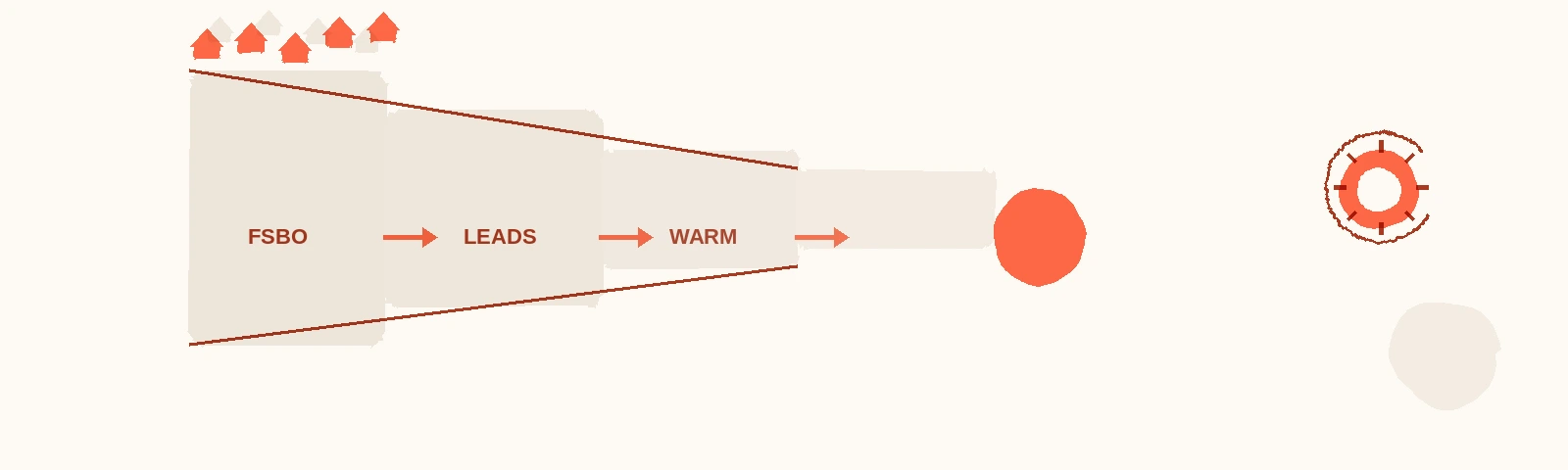
A self-filling FSBO pipeline is a system that continuously monitors property portals for new For-Sale-By-Owner listings, captures seller details, scores them for motivation, and delivers qualified contacts to you without manual scanning. Instead of checking portals yourself, the pipeline checks for you — every 10 minutes, across every relevant portal — and notifies you only when a high-potential seller appears.
The concept is not complicated: automate the detection, filter for quality, and deliver only what deserves a call. What makes it powerful is the consistency. A manual process depends on your schedule, your energy, and your memory. A pipeline depends on none of those.
According to the National Association of Realtors, 10% of home sales in the US are FSBO, and in European markets like Spain and Germany, private seller listings represent 25-37% of portal activity. That is a significant volume of motivated sellers posting new listings every single day. The question is whether you are seeing them all — or only the ones that happen to appear during your morning scroll.
How do you set up automated FSBO monitoring?
The foundation of any self-filling pipeline is automated monitoring that scans portals at regular intervals and flags new FSBO listings the moment they appear. This eliminates the single biggest failure point in manual prospecting: timing gaps between when a seller posts and when you find them.
There are three layers to effective monitoring:
Layer 1 — Portal coverage. Identify every portal where private sellers in your area post listings. In most European markets, this means 3-5 major portals. Many brokers only check one or two, which means they are missing 30-50% of available FSBO inventory from day one.
Layer 2 — Scan frequency. The difference between checking a portal once a day and checking every 10 minutes is enormous. Research from InsideSales.com shows that the odds of qualifying a lead drop by 400% when response time moves from 5 minutes to 10 minutes. If you are checking portals once a morning, you are already hours behind on most new listings.
Layer 3 — Deduplication. Without a deduplication system, you waste time reviewing listings you have already seen or already contacted. A proper pipeline marks every listing it has surfaced and never shows it to you again unless something changes — a price drop, a re-listing, or a description update that signals increased motivation.
Here is what a basic monitoring setup looks like compared to manual scanning:
| Element | Manual Scanning | Automated Pipeline |
|---|---|---|
| Portals checked | 1-2 | 3-5+ |
| Scan frequency | Once daily | Every 10-15 minutes |
| New listings found/day | 5-10 | 15-30+ |
| Time spent scanning | 45-90 min | 0 min |
| Listings missed | 30-60% | Under 5% |
The math is clear: automation does not just save time, it expands coverage. You see more sellers, faster, with zero scanning effort.
How do you score FSBO leads for motivation?
Not every FSBO listing deserves a call. A self-filling pipeline without a scoring layer will drown you in low-quality contacts. The key is identifying which sellers are most likely to convert — and that comes down to reading motivation signals embedded in the listing itself.
Motivation scoring assigns a priority to each new FSBO lead based on observable behaviors. The three strongest signals are:
1. Price reductions. A seller who drops their asking price has publicly admitted that their initial expectations did not work. Data from Zillow shows that homes with one or more price reductions sell 46% faster once a broker gets involved, because the seller’s resistance to professional help has already started breaking down.
2. Days on market. The longer a FSBO listing sits without selling, the more frustrated the seller becomes. The critical window is 21-45 days. Before 21 days, most sellers still believe they can do it alone. After 45 days, they are often burned out and actively considering professional help. A pipeline that flags listings entering this window gives you perfectly timed outreach.
3. Listing quality signals. Poor photos, incomplete descriptions, and missing floor plans are not just aesthetic problems — they are evidence that the seller lacks the marketing skills to sell effectively. These listings have the highest conversion rate to listing appointments because the seller can see the quality gap between their effort and a professional presentation.
A scored pipeline might look like this:
| Signal | Score Weight | Why It Matters |
|---|---|---|
| Price reduction (any) | +30 points | Seller adjusting expectations |
| Days on market > 21 | +20 points | Frustration building |
| Days on market > 45 | +40 points | Strong conversion window |
| Poor photo quality | +15 points | Marketing skill gap visible |
| Re-listed after removal | +35 points | Previous attempt failed |
| Description mentions “urgent” or “relocating” | +25 points | External timeline pressure |
Leads scoring above 60 points get an immediate call. Leads scoring 30-60 go into a nurture sequence. Leads below 30 get monitored but not actively pursued until their score changes. This approach to lead qualification is what separates productive prospecting from busy work.
What does a daily pipeline workflow look like?
A self-filling pipeline changes your morning from reactive scanning to proactive calling. Instead of spending the first hour finding leads, you spend it working the leads your pipeline already found.
Here is what a typical day looks like once your pipeline is running:
7:00 AM — Pipeline delivers overnight results. While you slept, the pipeline scanned all portals for new FSBO listings, scored each one for motivation signals, and queued the top contacts for your morning.
7:15 AM — Review and prioritize. You open your queue and see 8-12 new contacts, sorted by motivation score. The top 3-4 are high-priority sellers showing price drops or extended time on market. The rest are new listings worth monitoring.
7:30 AM — Start calling. You call the highest-scored leads first, during the golden window when they are most likely to answer. By the time competitors finish their manual portal scan at 9 AM, you have already spoken to 3-4 sellers.
Throughout the day — Real-time alerts. When a new high-scoring listing appears — a price drop on an existing listing, a re-listing after removal — the pipeline notifies you immediately. You call within minutes, not hours.
End of day — Pipeline resets. Contacted leads move to your follow-up system. Uncontacted leads stay in the queue for tomorrow. New listings continue accumulating overnight.
The difference in output is measurable. A broker running manual FSBO prospecting typically contacts 5-8 new sellers per week. A broker with an automated pipeline contacts 15-25. Over a quarter, that compounds into a dramatically larger opportunity pool.
How do you convert FSBO contacts into listing appointments?
Finding FSBO sellers is half the equation. Converting them requires an approach that respects where they are in their journey — they chose to sell privately for a reason, and that reason matters.
The biggest mistake brokers make with FSBO outreach is leading with a pitch. The seller has already rejected the idea of hiring a broker (that is why they are selling privately). Opening with “I can sell your home faster” triggers the exact resistance they have already committed to.
What works instead is a value-first approach:
First contact — Lead with market intelligence. Share something the seller does not have: comparable sales data, neighborhood trend information, or a specific observation about their listing. “I noticed your property on [portal]. The two-bedroom market in your area has shifted since last quarter — recent comparable sales suggest your price point may be attracting the wrong buyer segment.” This positions you as an advisor, not a salesperson.
Second contact — Offer a specific, no-obligation resource. A comparative market analysis, a professional photo review, or a buyer-interest report for their area. Something concrete that demonstrates your expertise without asking for a commitment.
Third contact — Reference the timeline. “Your listing has been active for [X] weeks now. In my experience, properties in your neighborhood that reach this point without offers typically need a strategy adjustment. I have worked with several homeowners in a similar position — happy to share what worked for them.”
According to the speed-to-lead research, reaching a seller within 5 minutes of a trigger event (price drop, re-listing, new inquiry) increases your conversion probability by 900% compared to waiting 30 minutes. A pipeline that delivers real-time alerts makes this kind of speed possible.
The conversion math is straightforward. If your pipeline delivers 20 qualified FSBO contacts per week and you convert 10-15% to listing appointments (which is achievable with proper scoring and timely outreach), that is 2-3 new listing appointments every week. Over a year, that compounds into a fundamentally different business.
How do you avoid the most common FSBO pipeline mistakes?
A pipeline only works if you avoid the traps that cause most automated systems to underperform. The three most common mistakes are:
Mistake 1 — Monitoring too few portals. Brokers tend to check the portal they are most familiar with and ignore others. In most markets, FSBO sellers post on 2-3 portals, often not the same ones. If you are only monitoring one, you are structurally missing a significant share of available inventory.
Mistake 2 — Treating all FSBO leads equally. A fresh listing from a confident seller at market price requires a completely different approach than a 60-day listing with two price drops. Without scoring, you waste premium calling time on leads that are not ready and miss the ones that are.
Mistake 3 — No follow-up system after first contact. Most FSBO conversions do not happen on the first call. They happen on the third, fourth, or fifth touch — usually after a specific frustration event (a viewing that went poorly, a lowball offer, a financing fall-through). Without a structured follow-up sequence, you abandon leads right before they are ready to convert.
The pipeline fills your top of funnel. Scoring tells you who to prioritize. Follow-up is what turns priority contacts into signed listings.
FAQ
How many FSBO leads should a pipeline generate per day?
In a typical urban or suburban market, a properly configured pipeline monitoring 3-5 portals should surface 3-5 new FSBO listings per business day. Not all will be high-priority — expect 1-2 high-scored leads daily, with the rest requiring nurture. The exact number depends on market size, portal coverage, and how you define your target area. A pipeline generating fewer than 10 new leads per week likely has a coverage gap.
How long does it take to see results from a FSBO pipeline?
Most brokers see their first listing appointment from pipeline-sourced leads within 2-4 weeks of consistent operation. The pipeline needs 1-2 weeks to build an initial inventory of monitored listings and begin detecting motivation signals like price drops and time-on-market thresholds. The compounding effect becomes visible after 60-90 days, when your monitored inventory is large enough to produce multiple high-scored leads weekly.
Can a solo broker run an automated FSBO pipeline?
Yes, and solo brokers benefit the most from automation because they cannot delegate manual scanning to anyone. The entire point of a self-filling pipeline is that it replaces the hours a solo broker would spend on portal monitoring. The time saved — typically 45-90 minutes daily — goes directly back into calling and client meetings, which is where revenue is actually generated.